However, behind the lifestyle freedom and creative independence lie serious challenges that every freelance designer must face.
Unlike full-time jobs, freelancing comes with uncertainty, responsibility, and constant self-management.From irregular income and difficult clients to burnout and long-term instability,
freelance designers must balance creativity with business skills.
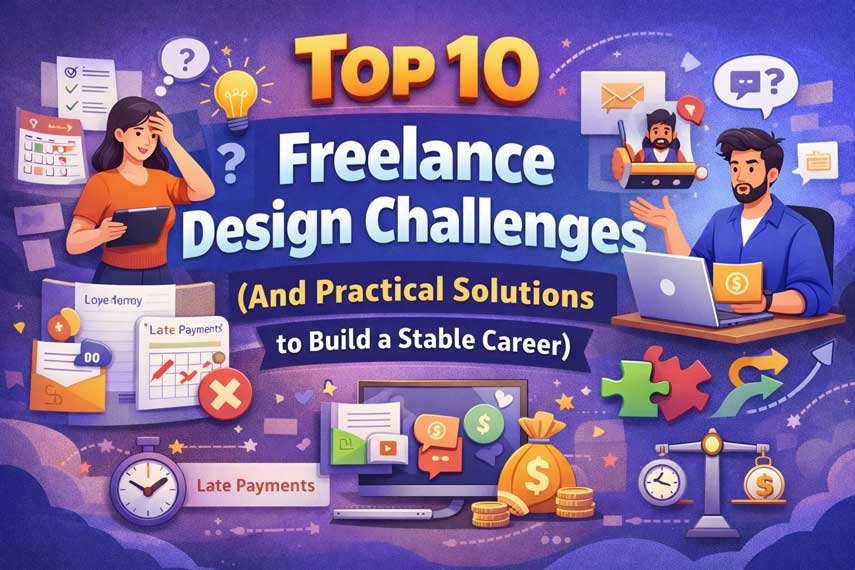
In this article, we explore the top 10 freelance design challenges,
their real impact, and practical solutions to overcome them.
1. Irregular Income & Cash Flow Issues
One of the biggest challenges freelancers face is irregular income.
Unlike salaried employees, freelancers don’t receive a fixed monthly paycheck.
Some months are financially strong, while others can be stressful and uncertain.
Late payments from clients often make the situation worse.
This unpredictability makes it difficult to plan expenses, save money, or feel financially secure.
Solution:
- Take 30–50% advance payment before starting any project
- Always use written contracts with payment terms
- Build a 3–6 month emergency fund for slow periods
2. Finding Consistent Clients
Many freelance designers struggle to find consistent, high-quality clients.
Platforms like Upwork and Fiverr are highly competitive, making it hard to stand out.
Relying only on marketplaces often leads to price competition and unstable work.
Solution:
- Build a niche (such as SaaS UI, Web3, or eCommerce design)
- Use LinkedIn to attract inbound leads
- Create case studies that show results, not just visuals
3. Scope Creep (Endless Revisions)
Scope creep happens when clients request “small changes” that gradually turn into major redesigns.
Without boundaries, freelancers often end up doing extra work without additional pay.
Solution:
- Define revision limits clearly in the contract
- Document deliverables in detail
- Charge separately for additional changes
4. Underpricing Your Work
Many freelance designers undervalue their work due to fear of losing clients or intense competition.
Underpricing leads to overwork, stress, and slow career growth.
Solution:
- Price your services based on value, not hours
- Avoid competing on the lowest price
- Increase your rates gradually as your experience grows
5. Difficult Clients
Not all clients are easy to work with.
Some delay feedback, constantly change requirements, or micromanage every detail.
These situations can drain time, energy, and creativity.
Solution:
- Qualify clients before accepting projects
- Set clear communication boundaries
- Use written agreements for expectations and timelines
6. Work-Life Imbalance
Freelancers often overwork because income is directly linked to effort.
Without clear boundaries, work can spill into nights, weekends, and personal time.
Solution:
- Set fixed working hours
- Avoid weekend commitments when possible
- Schedule regular breaks to recharge
7. Isolation & Lack of Team Collaboration
Working alone can feel isolating.
Freelancers miss the collaboration, feedback, and social interaction of a team environment.
Over time, this isolation can affect creativity and motivation.
Solution:
- Join online design communities
- Network actively on LinkedIn
- Attend online and offline design meetups
8. Managing Multiple Roles
Freelancers are not just designers.
They handle marketing, sales, accounting, client communication, and project management.
Managing all these roles can be overwhelming.
Solution:
- Use tools like Notion for task and project management
- Automate invoices and follow-ups
- Outsource repetitive or low-value tasks
9. Burnout & Creative Block
Constant deadlines, revisions, and pressure can lead to burnout.
Creative block reduces motivation and affects the quality of work.
Solution:
- Work on personal or experimental projects
- Schedule no-client days
- Invest time in learning new skills
10. Lack of Long-Term Stability
Freelancers don’t get benefits like health insurance, paid leave, or job security.
This lack of long-term stability can cause anxiety about the future.
Solution:
- Diversify income through templates, courses, or design systems
- Build a strong personal brand
- Secure retainer clients for steady income
References & Learning Resources
The insights in this article are based on widely accepted freelance and design best practices,
inspired by trusted industry resources:
Smashing Magazine – Freelance & Design Insights
Nielsen Norman Group – UX & Professional Practices
UX Design (Medium)
Freelancers Union – Freelance Career Resources
Useful UI/UX Design Resources & References
Below is a curated list of UI components, templates, branding assets, and UX research articles from Make Mockup to help designers and researchers work more efficiently.
UI Components by Design Tool
Figma UI Components
– Ready-to-use UI components optimized for Figma to speed up interface design.
Adobe XD UI Components
– High-quality UI components built for Adobe XD workflows.
Adobe Illustrator UI Components
– Scalable and customizable UI components for Illustrator users.
Adobe Photoshop UI Components
– Professionally designed UI elements compatible with Photoshop.
Design Assets & Resources
Browse All Resources
– Explore all UI kits, templates, and design assets in one place.
All UI Components
– A complete collection of UI components for web and mobile projects.
UI & UX Templates
– Pre-designed templates to kick-start your design projects.
Branding Resources
– Brand kits, style guides, and identity design assets.
UI/UX Blog & Research Articles
Make Mockup Blog
– Articles, tutorials, and insights on UI/UX design and research.
Types of UI/UX Research
– An overview of common UI/UX research methods and their use cases.
AI UI Design vs Normal UI Design
– Key differences between AI-driven UI design and traditional approaches.
Ethical Issues in UX Research
– How to assess ethical considerations across various research methods.
Choosing the Right Research Method
– Step-by-step guidance for selecting UX research methods.
Qualitative vs Quantitative UX Research
– Learn when and why to use each research approach.