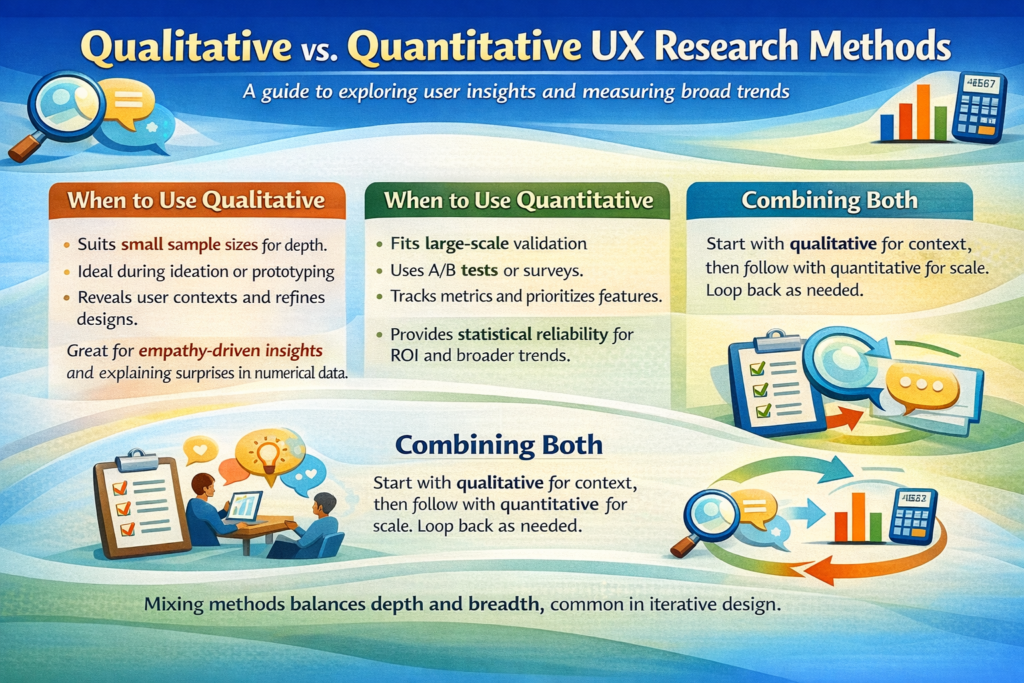
Qualitative UX research methods uncover user motivations, emotions, and pain points through open-ended insights, while quantitative methods measure behaviors, patterns, and performance with numerical data. Use qualitative early in discovery to explore “why” questions and generate ideas, and quantitative later for validation and benchmarking “what” or “how much” occurs.
When to Use Qualitative
Qualitative suits small sample sizes for depth, like interviews or usability tests during ideation or prototyping to reveal user contexts and refine designs. It excels when needing empathy-driven insights or explaining unexpected quantitative results.
When to Use Quantitative
Quantitative fits large-scale validation, such as A/B tests or surveys, to confirm hypotheses, track metrics, or prioritize features post-prototype. It provides statistical reliability for ROI decisions and broad trends.
Combining Both
Mixed methods offer the fullest picture—start with qualitative for context, follow with quantitative for scale, then loop back as needed. This approach, common in iterative design, balances depth and breadth for robust outcomes.